Best Kayaks for Big and Tall Paddlers (2026 Picks)
Discover the best kayaks for big and tall paddlers with high weight capacities, generous legroom, and wide stable hulls designed for larger frames.

Paddlers over 6'2" or 230 pounds often struggle with cramped cockpits, sunken waterlines, and tippy hulls designed for smaller bodies. Choosing a boat built specifically for larger frames restores stability, tracks straight under load, and keeps your hips and knees comfortable through hours on the water. In this guide, we break down top-performing high-capacity kayaks, essential hull specifications, and setup adjustments that turn cramped paddling into effortless cruising.
The 80% Weight Capacity Rule for Heavy Paddlers
Manufacturer weight limits can be deceptively optimistic. A boat rated for 300 pounds does not mean a 290-pound paddler can hop in with gear and expect a dry, stable ride. When a kayak approaches 100% of its maximum payload, the hull sinks deeper into the water column, dragging down your cruising speed and completely ruining secondary stability.
To keep your boat riding high and stable, follow the 80% Rule:
- Calculate total load: Combine your body weight, clothing, PFD, paddle, anchor, tackle, and drinking water.
- Multiply maximum capacity by 0.80: This figure represents your true usable weight capacity.
- Target payload cushion: If you weigh 260 pounds and carry 30 pounds of gear (290 pounds total), you need a kayak rated for at least 365 pounds.
When a hull rides at its ideal waterline, scupper holes drain efficiently on sit-on-top decks, and tracking channels bite into the water properly. Overloading forces the stern down, raising the bow like a plow and turning every paddle stroke into an uphill battle.
Key Features Big and Tall Paddlers Must Check
Finding the right boat isn't just about weight limits. A 6'5" paddler weighing 210 pounds has completely different ergonomics than a 5'10" paddler weighing 280 pounds. You need to inspect four core architectural features before making a purchase.
1. Beam Width and Volume Distribution
Beam width (the maximum distance across the kayak at its widest point) directly dictates initial stability. Standard recreational kayaks sit between 28 and 30 inches wide. For larger paddlers, look for a beam of 32 to 36 inches. Additionally, look for hulls with full volume carried out toward the bow and stern rather than tapering sharply, which keeps the boat balanced when you lean back or recline in the seat.
2. Deck Configuration: Sit-On-Top vs. Sit-Inside
While sit-inside kayaks offer shelter from wind and spray, their rigid cockpit rims (coamings) severely restrict tall paddlers. Entering and exiting a small cockpit rim with a 34-inch inseam requires awkward twisting that can easily capsize the craft at the dock. As detailed in our breakdown of sit-in vs sit-on-top kayaks, open-deck sit-on-top kayaks are generally superior for large frames because they eliminate cockpit coaming restrictions entirely.
3. Seat Architecture and Hip Clearance
Cheap kayaks rely on molded plastic seat wells with thin foam pads glued to the floor. For heavy paddlers, this puts immense pressure on the tailbone and sciatic nerve. Look for raised, lawn-chair style aluminum frame seats with breathable mesh. Raised seats sit 3 to 6 inches above the deck floor, allowing your knees to rest at a natural, comfortable bend rather than sprawling flat against plastic sidewalls.
4. Footrest Range and Legroom
Tall paddlers need a minimum deck length or foot brace track range that accommodates long legs without forcing knees against scupper tracks or gear rails. Molded-in footwells can be frustrating if your ideal leg extension falls right between two molded steps. Adjustable foot pegs on anodized aluminum tracks provide precise 1-inch incremental adjustments.
Quick Comparison: Top Kayaks for Big & Tall Paddlers
| Model | Type | Length / Width | Max Capacity | Hull Weight | Best For | Check Price |
|---|---|---|---|---|---|---|
| Ocean Kayak Malibu Two XL | Tandem / Solo Sit-On-Top | 13'4" / 34" | 500 lbs | 68 lbs | Maximum Legroom & Weight Capacity | Amazon |
| Perception Pescador Pro 10.0 | Compact Sit-On-Top | 10'6" / 32" | 325 lbs | 57 lbs | Heavy Solo Paddlers Needing Portability | Amazon |
| Sea Eagle 370 Pro | Inflatable Tandem / Solo | 12'6" / 34" | 500 lbs | 32 lbs | Tall Paddlers with Zero Storage Space | Amazon |
| Lifetime Tamarack Angler 100 | Budget Sit-On-Top | 10'0" / 31" | 275 lbs | 52 lbs | Medium-Large Paddlers on a Budget | Amazon |
| Pelican Argo 100X | Sit-Inside | 10'0" / 28" | 275 lbs | 36 lbs | Light-to-Medium Tall Paddlers Wanting Shell Protection | Amazon |
| Intex Explorer K2 | Budget Inflatable | 10'3" / 36" | 400 lbs | 30 lbs | Casual Flatwater Recreation | Amazon |
Detailed Reviews of the Best Kayaks for Big and Tall
1. Ocean Kayak Malibu Two XL
For paddlers over 6'4" or those weighing over 280 pounds, single-person recreational kayaks can feel cramped. Paddling a spacious tandem kayak like the Ocean Kayak Malibu Two XL solo is an ideal workaround. By positioning the seat in the center molded harness spot, you get a balanced center of gravity, an incredible 500-pound max weight capacity, and unobstructed legroom.
- Length: 13'4"
- Width: 34 inches
- Capacity: 500 lbs
- Weight: 68 lbs
At 34 inches wide, the tri-form hull provides exceptional primary stability. You can lean over the gunwales without worrying about tipping. The open deck design means long legs can stretch out fully without bumping into hatch covers or console towers. On the downside, a 68-pound rotomolded polyethylene boat requires some effort to transport; using one of the best kayak carts and dollies makes moving it from vehicle to launch seamless. Check current pricing on Amazon.
2. Perception Pescador Pro 10.0
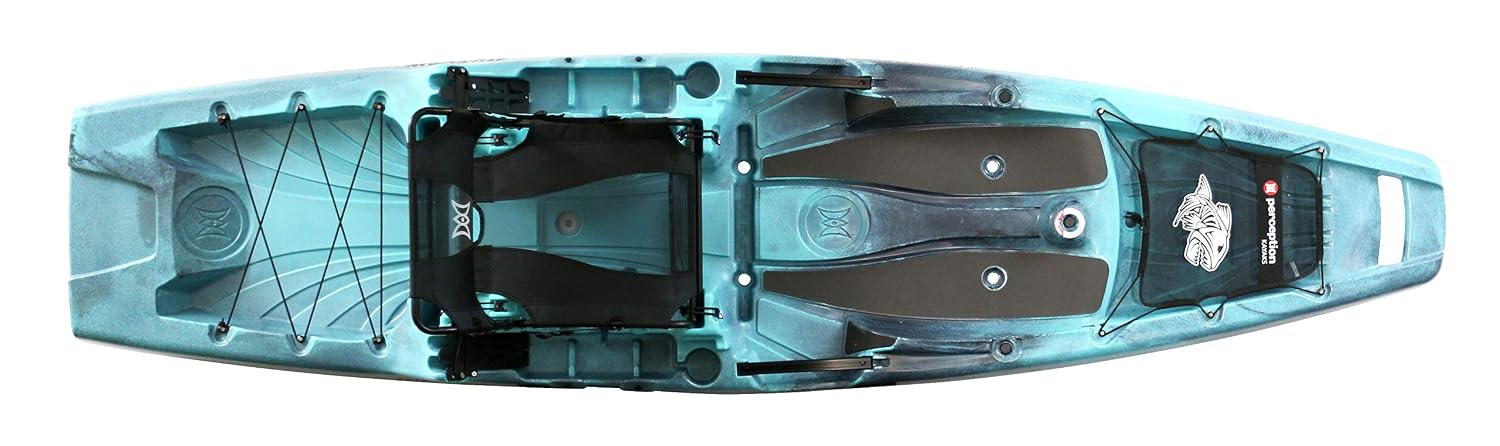
If you want a maneuverable single-person hull that still handles up to 325 pounds, the Perception Pescador Pro 10 is a standout candidate. Unlike budget 10-foot kayaks that sink under heavy loads, the Pescador Pro features a wide-arch multi-chine hull that displaces water effectively while preserving tracking.
- Length: 10'6"
- Width: 32 inches
- Capacity: 325 lbs
- Weight: 57 lbs
The centerpiece for big paddlers is the Stadium-style frame seat. It adjusts to two distinct height positions: lower for enhanced stability in chop, and upper for comfortable seating and easier standing. The open tankwells front and rear provide plenty of storage space for gear crates, making it an agile option covered in our roundup of the best fishing kayaks. View details on Amazon.
3. Sea Eagle 370 Pro
Inflatable kayaks are often overlooked by big paddlers who assume PVC air chambers are flimsy. In reality, high-volume inflatable pontoons offer buoyant displacement that hard-shell plastic struggles to match. The Sea Eagle 370 supports up to 500 pounds while weighing just 32 pounds inflating out of a duffel bag.
- Length: 12'6"
- Width: 34 inches
- Capacity: 500 lbs
- Weight: 32 lbs
Because the seats attach via hook-and-loop fasteners along the I-beam floor, tall paddlers can position the movable inflatable seat as far back as necessary to give their legs complete freedom. The 38-mil Polycrylar hull handles dog claws and gravel shores easily. As outlined in our comparison of inflatable vs hard shell kayaks, this model is ideal if you drive a sedan or lack garage storage space. Check the latest price on Amazon.
4. Lifetime Tamarack Angler 100
For entry-level paddlers under 250 pounds who still need a wider deck and robust weight limit, the Lifetime Tamarack Angler 100 offers a solid 275-pound capacity at an affordable price point. Its flat-bottom hull with deep tracking channels gives broad support on calm lakes and slow rivers.
- Length: 10'0"
- Width: 31 inches
- Capacity: 275 lbs
- Weight: 52 lbs
Multiple molded-in footrest positions allow paddlers up to roughly 6'2" to find a workable leg angle. While the stock padded seat back is basic compared to high-end frame seats, its high-density polyethylene construction stands up to rough handling. If you are learning the ropes and consulting our how to choose a kayak buyers guide, the Tamarack offers an accessible entry point. See listing on Amazon.
5. Pelican Argo 100X
Sit-inside kayaks are tricky for big frames, but the Pelican Argo 100X accommodates moderately tall paddlers better than most traditional designs thanks to its enlarged cockpit opening measuring 55 inches long by 24 inches wide.
- Length: 10'0"
- Width: 28 inches
- Capacity: 275 lbs
- Weight: 36 lbs
Weighing only 36 pounds thanks to RAM-X twin-sheet thermoformed material, the Argo 100X is easy to car-top. The open cockpit design allows long legs to slide in easily without scraping knees on the coaming. However, with a 275-pound max limit and 28-inch beam, this boat is best suited for tall, lean paddlers rather than heavy-set individuals. Check details on Amazon.
6. Old Town Loon 120
If you want the roomiest sit-in cockpit on this list, the Old Town Loon 120 is the one to paddle. The oversized cockpit opening and sliding foot braces give tall paddlers real leg room instead of a cramped keyhole.
- Length: 12'0"
- Width: 30 inches
- Capacity: 375 lbs
- Weight: 54 lbs
The Glide Track seating system adjusts fore and aft on the fly, so heavier paddlers can trim the boat rather than fight it, and the framed seat with a tall padded backrest supports your lower back through a long day. Twelve feet of waterline also means it tracks straight instead of wandering — the usual complaint with short, wide high-capacity hulls. View on Amazon.
Gear Setup and Ergonomics for Larger Paddlers
Buying a high-capacity hull is only half the battle. To paddle efficiently without shoulder fatigue, lower back pain, or cramped hips, you need to match your physical dimensions with appropriately sized accessories.
Sizing Your Paddle for Wide Beams
Paddle length must scale up with both paddler height and hull width. Standard 220cm paddles force tall paddlers in wide (32" to 36") boats to scrape their knuckles along the gunwales or steepen their stroke angle awkwardly, leading to quick fatigue.
- 31 to 33 inch boat width: Use a 230cm to 240cm paddle.
- 34 to 36+ inch boat width: Use a 240cm to 250cm paddle.
- If your torso is unusually tall, add an extra 10cm to prevent reaching over the side. Check out our guide to the best kayak paddles for top-rated high-angle and low-angle options.
PFD Fit and High-Back Clearance
Standard life jackets tend to ride up into the armpits of tall paddlers or pinch around the waist of heavier individuals. Look for Type III PFDs with thin-profile mesh backs and wide arm opening cuts. A mesh lower back is crucial when sitting in frame seats, as thick foam blocks push your lower torso forward and ruin your posture. Explore comfortable options in our round-up of the best kayak life jackets.
Transportation Considerations
High-capacity plastic kayaks often weigh between 65 and 90 pounds empty. Lifting a heavy, 34-inch wide hull onto a tall SUV roof rack solo can cause back strain or damage your vehicle. If you drive a pickup, consult our guide on how to transport a kayak in a truck bed to load your boat safely using bed extenders or simple tie-down setups.
Frequently asked questions
How much weight capacity do I actually need if I weigh over 250 pounds?
If you weigh over 250 pounds, target a kayak with a minimum rated maximum weight capacity of 350 to 400 pounds. Taking into account the 80% usable capacity rule, a 350-pound limit ensures your 250-pound body weight plus 30 pounds of clothing, water, and gear leaves enough buoyant hull displacement to keep scupper holes draining dryly and hull tracking sharp.
Are sit-on-top or sit-inside kayaks better for tall paddlers with long legs?
Sit-on-top kayaks are far superior for tall paddlers because they feature open decks without rigid cockpit rims that restrict long legs or trap knees. On a sit-on-top hull, tall paddlers can stretch their feet past molding barriers, adjust elevated frame seats backward, and safely swing their legs over the side for easy entry and exit at docks or shorelines.
Can a tall or heavy paddler comfortably paddle a tandem kayak solo?
Tall and heavy paddlers can comfortably and effectively paddle many tandem kayaks solo by setting up their seat in the middle position. Tandem hulls usually offer 400 to 500 pounds of weight capacity and generous deck lengths over 12 feet, providing exceptional stability and ample legroom that shorter single-person kayaks cannot match.
What paddle length do I need for a wide, high-capacity kayak?
If your high-capacity kayak features a wide beam between 32 and 36 inches, you should choose a paddle that is between 240cm and 250cm long. Using a standard 220cm or 230cm paddle on a broad boat forces you to reach awkwardly over the gunwales, resulting in banged knuckles, inefficient strokes, and excessive torso strain over long distances.
The bottom line
Being a big or tall paddler shouldn't mean settling for wet seats, cramped legs, or sluggish hulls. Prioritize a wide beam (32"+), an open sit-on-top deck with an adjustable mesh frame seat, and a weight rating that comfortably exceeds your total load using the 80% rule. For maximum capacity and unrestricted legroom, tandem boats like the Ocean Kayak Malibu Two XL paddled solo are hard to beat, while agile performers like the Perception Pescador Pro 10 prove you don't have to sacrifice solo maneuverability to get strong, reliable support on the water.
Related Kayaks
Kayaks that pair with this guide
Pescador Pro 10.0

Pungo 120

Catch Mode 110
Keep Reading
Related articles

Best Tandem Kayaks of 2026: Top 2-Person Models

The Best Inflatable Kayaks of 2026: Top Portable Picks

The Best Lightweight Kayaks of 2026: Easy to Lift & Launch
Next up: Best Tandem Kayaks of 2026: Top 2-Person Models, The Best Inflatable Kayaks of 2026, and Easy to Lift & Launch.