Wilderness Systems Pungo 120 vs Old Town Loon 120
Quick verdict
Choose the Pungo if its cockpit fits you and the lower catalog hull weight simplifies your routine; investigate the Loon when its seating arrangement and higher load allowance solve your needs. Both are recreational sit-insides, so comfort, full load, recovery, and intended water matter more than a universal winner.

Spec comparison
Specifications below come from our catalog. Unavailable values are left blank; listed capacity includes paddler and gear.
| Specification | Pungo 120 | Loon 120 |
|---|---|---|
| Type | Sit-inside | Sit-inside |
| Length | 12' 2" | 12' 0" |
| Width | 29" | 30" |
| Weight | 49 lb | 54 lb |
| Capacity | 350 lb | 375 lb |
| Material | Rotomolded polyethylene | Rotomolded polyethylene |
Who each boat is for
Wilderness Systems Pungo 120
The Pungo is a recreational sit-inside to investigate when a comfortable cockpit and manageable ownership routine matter. In our catalog it is lighter than the Loon, with a slightly narrower beam and lower capacity. Those differences give you practical questions to ask about fit and carrying, rather than evidence of a guaranteed handling advantage.
Consider it for suitable sheltered outings when you want an enclosed seating layout without assuming you need an expedition-oriented sea kayak. Check how the seat and foot supports fit your body, how easily you enter and leave, and whether your usual equipment can be arranged securely. A model's strong reputation does not replace individual fit.
Old Town Loon 120
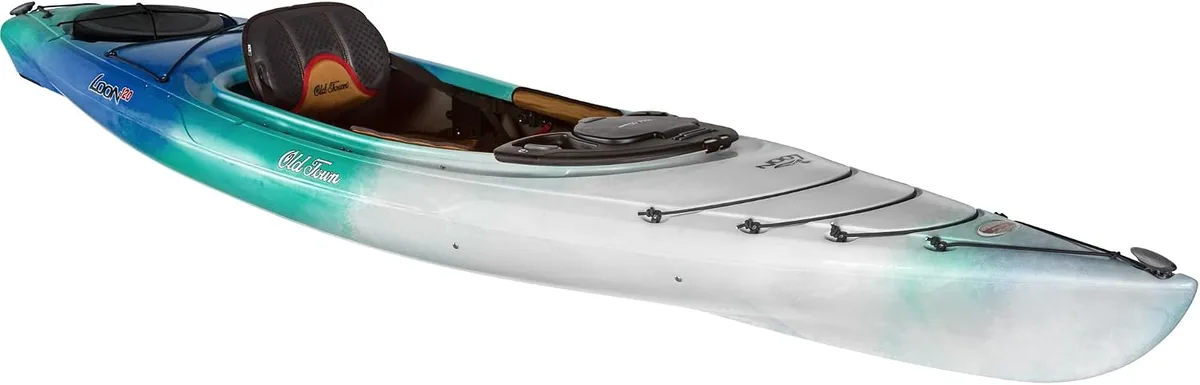
The Loon is worth investigating when cockpit comfort, adjustability, and carrying your planned load are central to the decision. The catalog gives it a higher capacity and slightly wider beam than the Pungo, alongside a higher hull weight. That may be useful for your requirements, but it also changes the transport task.
Old Town describes an adjustable seating system and removable work deck on its model page. Those features are reasons to inspect the actual layout, not a promise that it will fit every larger paddler. Compare how you sit, reach essentials, and exit with your PFD and normal footwear before choosing.
Key differences
Stability and tracking
Both boats are recreational sit-insides in the catalog. The Loon's broader listed beam is a small dimensional distinction, not proof of a universal stability advantage. Hull shape, seat position, load distribution, and your technique affect the feel of the boat when level and when leaned.
Similarly, the Pungo's narrower beam does not establish that it is faster, and the near-similar overall lengths do not tell the whole tracking story. Wind, trim, stroke technique, and the underwater hull shape all matter. Ask for a supervised demonstration in appropriate conditions if ordinary handling is your deciding concern.
Do not confuse either boat with a dedicated sea kayak because it has an enclosed deck. A roomy recreational cockpit and comfortable seat do not certify suitability for exposed crossings. Match your intended water to the manufacturer's guidance and the rescue equipment and skills the actual boat requires.
Comfort and cockpit fit
The most valuable comparison is the one you make while sitting properly supported. Check foot-brace reach, legroom, back support, and whether the seat encourages a relaxed upright position. Your body proportions can matter more than height alone, and a wider hull does not necessarily mean a better-fitting cockpit.
The Loon's manufacturer-described adjustability deserves a practical inspection: can you use the controls easily, and does the setup support your legs and back? Assess the Pungo's actual seating arrangement in the same way rather than awarding comfort from a feature list. Keep your PFD on during any fit check.
Entry and exit deserve equal attention. Check footwear clearance, how you move your legs, and whether gear near the cockpit complicates leaving. If a spray skirt is part of your plan, confirm the appropriate fit and learn its release and wet-exit routine with qualified guidance.
Storage and capacity
The Loon's higher listed capacity may matter when your complete load approaches the Pungo's allowance. Include yourself, water, clothing, safety equipment, and bags rather than comparing capacity only with body weight. Maximum capacity is not a promise of ideal handling at that load.
Storage space and capacity answer different questions. A hull can have adequate load allowance while still lacking convenient space for bulky gear. Inspect storage access and seals, secure items low and balanced, and protect essentials in suitable dry storage rather than assuming a hatch is waterproof.
Old Town's removable work deck may appeal if you want a convenient place for small items, but it should not become an obstruction or a reason to leave equipment unsecured. Compare the day-trip arrangement you intend to use in both boats, including how quickly you can reach communication equipment.
Transport and weight
The Pungo's lower catalog weight is a useful advantage to investigate for solo handling. However, length, carrying handles, your vehicle height, and the path to the launch can still make either boat awkward. Bare-hull figures do not include every piece of equipment you move on an outing.
The Loon may be perfectly manageable with suitable storage, a cart, or assistance, but check that help is dependable. Rehearse moving the boat from storage to vehicle and back. The kayak transport guide is useful if a truck is part of that plan; always check the actual transport equipment and vehicle limits.
Price tier and ownership cost
These are more substantial recreational purchases than the simplest entry-level packages, but prices and included equipment change. Compare the live prices above with the seller's exact model and package rather than assuming a permanent price gap. Delivery, returns, seating accessories, and transport equipment can change the complete cost.
Neither price nor owner ratings establish the right boat for your body. Paying more is worthwhile only when the fit and features solve an actual need. Keep an appropriate PFD, paddle, immersion clothing, and instruction in the budget instead of treating the hull as the entire purchase.
Buying criteria
First, decide whether a recreational sit-inside fits your local water and the outings you actually expect. Use the how-to-choose buyer's guide to compare fit, equipment, transport, and storage. If this is your first boat, the beginner kayak guide provides a wider range of ownership compromises to consider.
Next, calculate the full load and inspect cockpit comfort rather than treating the higher capacity as a sizing chart. The big and tall paddler guide helps identify questions about body proportions, entry, and seating. It does not make one model automatically correct for every larger paddler.
Finally, learn what happens after a capsize in the actual boat. Read kayak safety essentials and seek guided recovery practice. Favor the Pungo if its fit works and easier handling on land is decisive; favor the Loon if its cockpit arrangement and load allowance justify the additional transport burden for you.
Manufacturer reference
The Old Town Loon 120 manufacturer page describes its seating, work deck, and outfitting. Confirm the current package and owner's instructions before purchase. The specification table here remains a catalog comparison rather than a blend of numbers from different model years or variants.
Frequently asked questions
Is the Pungo faster than the Loon?
The catalog dimensions do not establish a reliable speed ranking. Hull shape, load, wind, and paddling technique influence efficient travel. Compare how suitable each design is for your intended trips and, if possible, try them with an outfitter rather than relying on a narrower-is-faster assumption.
Which is better for a larger paddler?
The Loon has the higher listed capacity, but body proportions and cockpit comfort still need checking in both boats. Include your complete trip load and assess seat support, foot placement, and entry. Capacity alone does not guarantee a comfortable fit or ideal handling.
Can either be used on exposed coastal water?
Do not assume that an enclosed recreational boat is suitable for an exposed crossing. Consult the manufacturer, local instructors, and conditions, and assess flotation, outfitting, clothing, and recovery requirements. If exposed touring is your goal, investigate designs and training specific to that environment.
Contains Amazon affiliate links. Read our disclosure.