How to Transport a Kayak in a Truck Bed: 3 Ways That Actually Work
Three proven ways to haul a kayak in a pickup — tailgate down, tailgate up, or with a rack — plus the gear, straps, and DOT rules that keep it legal and scratch-free.
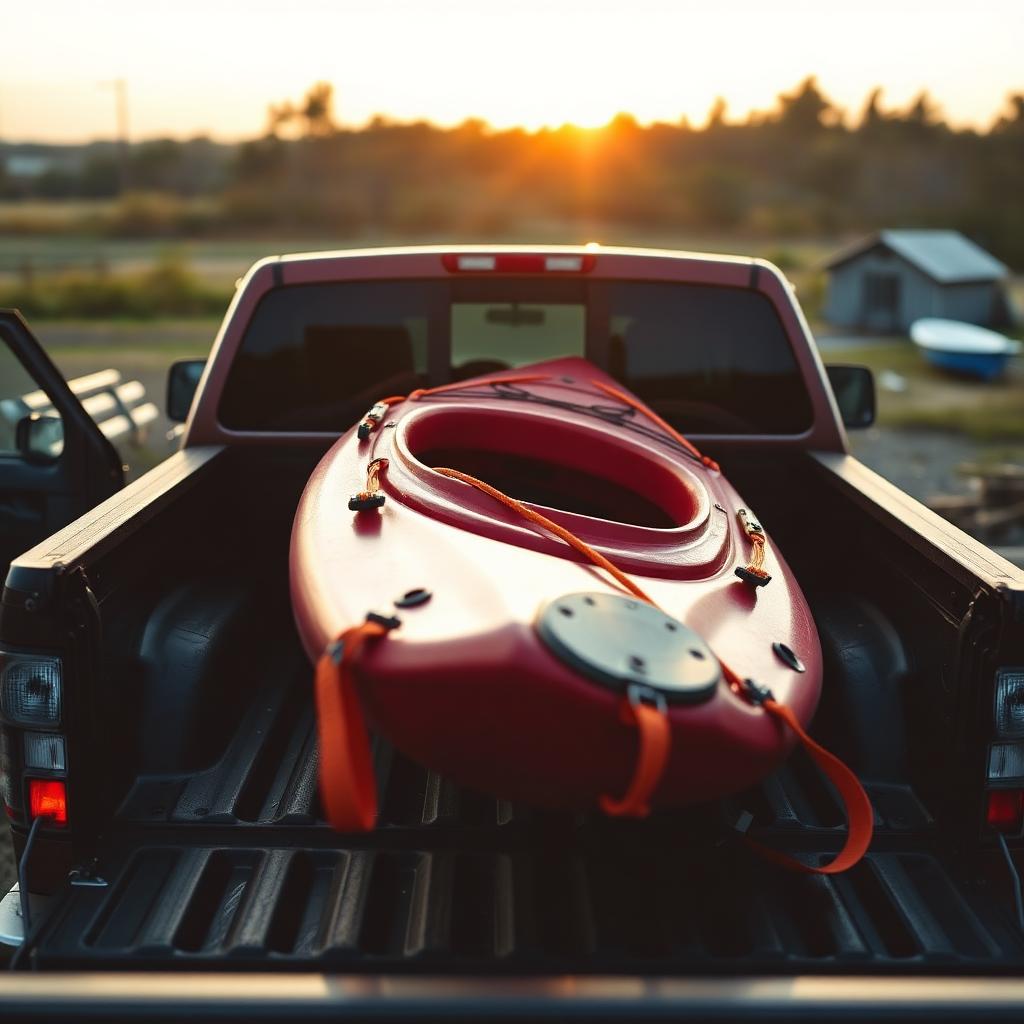
Hauling a kayak in a pickup is the fastest, cheapest way to get from driveway to launch — no roof rack, no lifting overhead, no wind noise on the highway. But "throw it in the bed" hides a few real decisions that change how safe, legal, and painless the trip actually is.
Below are the three setups almost every truck owner ends up choosing between, with the tradeoffs, gear, and step-by-step for each.
Quick comparison
| Setup | Best for | Cost | Downsides |
|---|---|---|---|
| 1. Tailgate down | Most people, most trips | $20 straps + red flag | Kayak overhangs; need a flag; tailgate is exposed |
| 2. Tailgate up | Short kayaks (≤10 ft), rough roads | $20 straps + a bed mat | Kayak rides high, can scratch cab, wind catches it |
| 3. Tailgate rack / extender | Long kayaks (12 ft+), frequent hauls | $120–$300 | Extra hardware, install time, storage |
Option 1: Tailgate down (the default)
This is what most anglers and weekend paddlers do, and for good reason — it's cheap, fast, and works with almost any kayak up to about 12 feet in a full-size bed.
How it works: Drop the tailgate flat, slide the kayak in bow-first with the stern hanging over the open gate. You get roughly 6 feet of bed plus another 2 feet of tailgate to support the hull. Anything past that overhangs into open air.
What you need:
- Two cam-buckle straps (avoid ratchet straps — they over-tighten and can dent a plastic hull)
- A bright red or orange flag for any load extending more than 4 ft past the tailgate (federal DOT rule; some states are stricter)
- Optional: a scrap of carpet or a bed mat so the hull doesn't slide on ribbed plastic bed liners
Step by step:
- Drop the tailgate and lay down a mat if you have one.
- Slide the kayak in bow-first, cockpit facing up, centered in the bed.
- Run one strap over the cockpit through the bed's front tie-down anchors. Snug, not crushing — you should be able to slip a finger under.
- Run a second strap over the stern, anchored to the tailgate hinge points or bed anchors near the tailgate.
- Tie a red flag to the stern grab handle.
- Give the kayak a firm shake side to side. If it moves more than an inch, tighten.
Watch out for: Overhang length. Federal rules cap overhang at 4 ft past the rearmost point of the vehicle before a flag is required, and some states require lights at night. If your kayak sticks out 5+ ft, this is a real ticket, not a theoretical one.
Option 2: Tailgate up (kayak rides higher)
Closing the tailgate turns the bed into a shorter, deeper box. The kayak rides on top of the closed tailgate and the bed rails, which lifts it up 12–18 inches higher than option 1.
Why anyone does this: Two situations. First, a very short kayak (8–10 ft) fits in the bed with the tailgate closed on many full-size trucks — no overhang, no flag, no legal question. Second, on rough dirt roads the kayak isn't bouncing off a horizontal tailgate hinge, which can crack cheap plastic tailgates over time.
What you need:
- Two cam-buckle straps
- Foam blocks or pool noodles cut in half, taped to the bed rails so the hull doesn't sit directly on painted metal
- Optional: a bed extender laid flat as a cradle
Step by step:
- Close the tailgate. Set foam blocks on both bed rails near the cab and near the tailgate.
- Lift the kayak in from the side and rest it on the foam blocks, cockpit up.
- Strap it down through the bed anchors, over the cockpit and over the stern.
- Confirm the bow isn't touching the back of the cab — a 6-hour highway trip will polish paint right off.
Watch out for: Wind. A kayak riding a foot above the bed rails is basically a sail. Above 60 mph you'll feel it push the truck around, and the straps will loosen faster than they do in option 1. Re-check straps every fuel stop.
Option 3: A tailgate rack or bed extender
If you haul a 12+ foot kayak, haul often, or haul two boats at once, dedicated hardware pays for itself in a season. There are two categories worth knowing:
Hitch-mounted bed extenders (roughly $120–$180). A T-shaped bar that slides into your 2-inch receiver and adds 2–4 feet of support behind the tailgate. The kayak rests on the extender and the closed tailgate — no overhang past the extender, no flag needed in most states, and the boat rides level.
Truck bed racks or over-cab racks (roughly $250–$500 for basic, $600+ for Yakima/Thule systems). Steel or aluminum uprights that bolt into the bed stake pockets and give you crossbars above the cab. Best for hauling long touring kayaks, hauling two boats, or hauling with the bed still usable for coolers and gear underneath.
Step by step (hitch extender):
- Slide the extender into the receiver, pin it, tighten the anti-rattle bolt.
- Close the tailgate. The extender sits behind it, forming a longer platform.
- Load the kayak bow-first onto the extender and tailgate.
- Strap over the cockpit to bed anchors, and strap the stern to the extender's crossbar.
- Bow line to the front tow hook is optional but smart on highway trips — it stops the kayak from sliding rearward under braking.
Watch out for: Weight rating. Cheap Amazon extenders are rated for 350 lb but that assumes a distributed load. A single 90-lb kayak is well within spec; a 300-lb tandem plus gear plus a passenger stepping on the extender to load it is not.
Which one should you pick?
- Recreational sit-on-top, 10 ft, weekends only: Option 1. Tailgate down, two straps, red flag. Done.
- Compact sit-on-top or inflatable in a hard case, under 10 ft: Option 2 if it fits with the tailgate closed. No overhang, no flag.
- Angler kayak with a pedal drive, 12 ft touring kayak, or two boats: Option 3. Get a hitch extender at minimum. Your back and your paint job will thank you.
Rules almost everyone forgets
- Red flag by day, red light by night. Federal minimum is a 12x12 inch red or orange flag for any overhang past 4 ft. At night, that overhang needs a light visible from 500 ft.
- State laws vary. California caps overhang at 4 ft past the rear. Texas allows 4 ft with a flag. Some states require lights any time visibility is under 1000 ft, not just at night.
- Never strap across the middle only. A single strap in the center lets the kayak pivot bow-to-stern in a hard stop. Always use bow AND stern straps.
- Cam-buckle over ratchet. Ratchets are for lumber. On plastic kayaks they crush hulls into permanent dents that ruin tracking.
Gear worth buying once
- Two 12-ft cam-buckle straps ($15–$20 for the pair)
- A DOT-compliant red flag ($5)
- A bed mat if you don't already have one — protects both the truck and the hull
- A hitch bed extender if you're hauling anything over 12 ft
That's it. A $40 strap-and-flag kit handles 90% of trips, and a $150 extender covers the rest. Roof racks are great when you need them, but for most truck owners, the bed is already the right answer.
Frequently asked questions
How far can a kayak legally stick out of a truck bed?
Rules vary by state, but the common pattern is that overhang beyond about 4 feet past the rear bumper requires a red or orange flag by day and a red light at night. Many states also cap total rear overhang, so check your own state's code before hauling a 12-foot boat with the tailgate down.
Do I need a bed extender for a 10-foot kayak?
Usually not. With the tailgate down, a standard 6.5-foot bed supports a 10-foot kayak with roughly 3 feet of overhang, which is legal in most states with a flag. Extenders start to matter for boats over about 12 feet or short 5.5-foot beds.
Is it safe to leave the tailgate up with the kayak angled?
Yes, and it is often the better option: the tailgate becomes a rear stop so the kayak cannot slide backward. Pad the tailgate edge, run one strap down through the bed and one forward to the front tie-down points, and check the straps after the first 10 minutes of driving.
Related Kayaks
Kayaks that pair with this guide
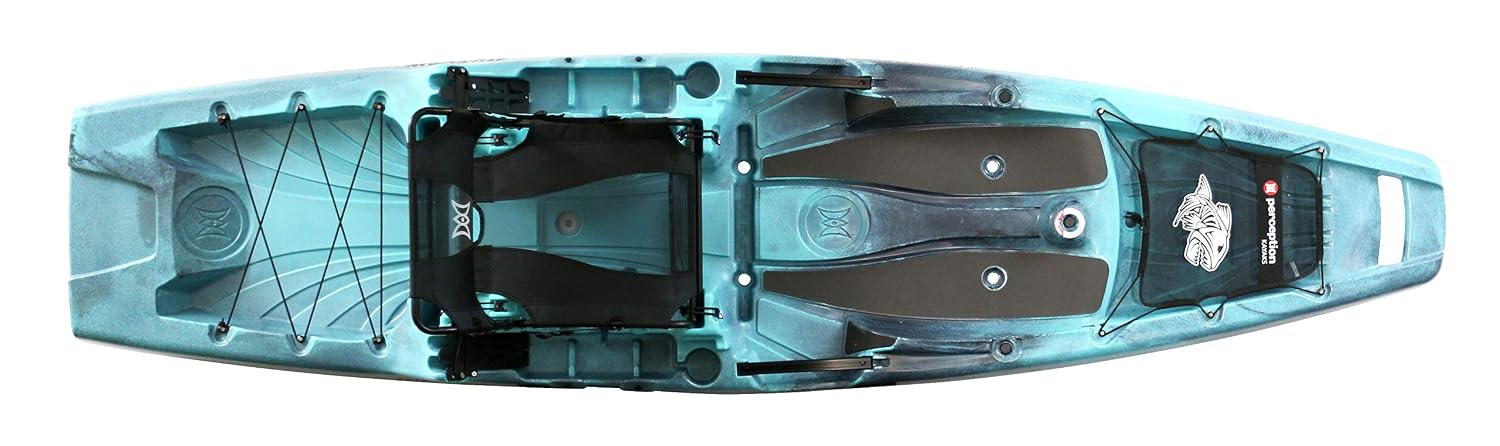
Pescador Pro 10.0

Catch Mode 110
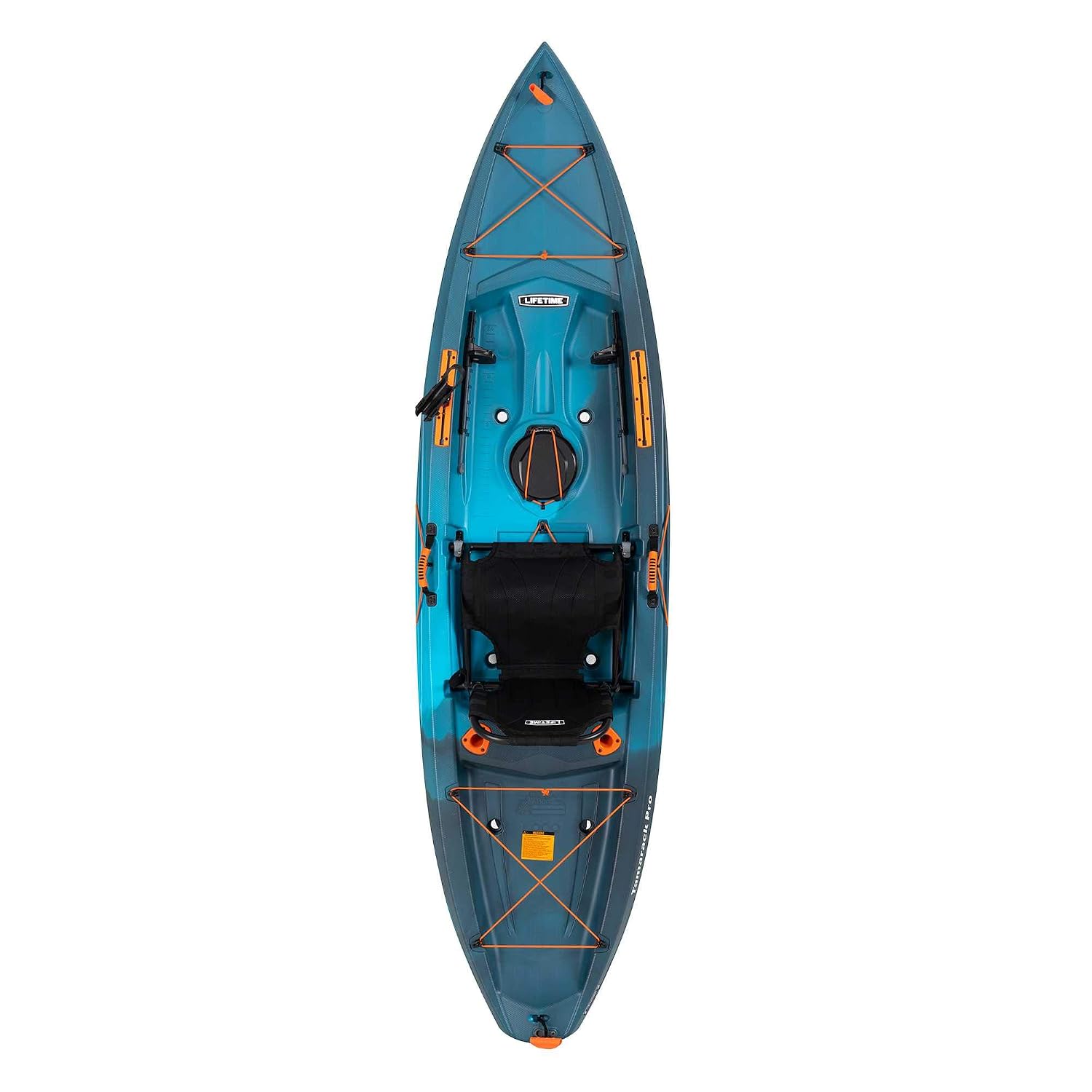
Tamarack Angler 100
Keep Reading
Related articles
Fishing From a Kayak: Techniques That Actually Catch Fish

Best Kayak Roof Racks: J-Cradles, Saddles & Assists
How to Transport and Store a Kayak Without Damaging It
Next up: Fishing From a Kayak: Techniques That Actually Catch Fish, Best Kayak Roof Racks, and to Transport and Store a Kayak Without Damaging It.