Best Kayak Trailer Options of 2026: Top Towables Tested
Stop breaking your back hoisting heavy fishing rigs. We review the best kayak trailers of 2026 for single, double, and multi-boat transport.

Investing in the best kayak trailer transforms hauling heavy hulls from a back-straining chore into a two-minute hitch-and-go operation. Whether you need to carry multiple 14-foot touring craft or a 120-pound motorized fishing rig, a dedicated trailer lowers your loading height to waist level and saves your vehicle's roof from dents. In this guide, we break down top-rated towables for every budget, capacity requirement, and vehicle type.
Roof Racks vs. Kayak Trailers: When to Make the Switch
For lightweight paddlecraft, a standard roof setup like those in our best kayak roof rack guide works well. However, as kayaks have grown wider, heavier, and more specialized, roof loading has become a serious physical challenge for many paddlers.
- Weight limits: Modern feature-loaded hulls frequently tip the scales at 80 to 130 pounds before adding gear. Hoisting a heavy hull onto a high SUV roof rack solo risks dropping the boat or damaging vehicle body panels.
- Vehicle aerodynamics: Stacking two large kayaks on top of a compact car creates immense drag, cutting fuel efficiency by up to 25 percent at highway speeds. Towing behind your vehicle keeps the load in the drafting envelope.
- Multi-boat capacity: Hauling three or four boats on top of one passenger car requires extra-wide crossbars and awkward side-stacking. A double or quad kayak trailer carries multiple full-sized hulls securely side-by-side.
- Ease of launch: Towing allows you to keep your craft fully rigged with gear, fish finders, and rod holders, driving right down to a paved boat ramp for an effortless launch.
To learn more about alternative transport methods before committing to a trailer, review our complete guide on how to transport and store a kayak as well as our advice on how to transport a kayak in a truck bed.
Key Anatomy of an Ideal Kayak Trailer
Not all light utility trailers handle long kayak hulls safely. Selecting the right rig requires understanding five crucial mechanical specifications.
Wheel and Tire Size
Small 8-inch tires spin significantly faster per mile than 12-inch or 13-inch highway tires at 65 miles per hour. This rapid rotation generates intense friction heat inside the wheel bearings, leading to premature axle failure if not constantly greased. For frequent highway travel, 12-inch or larger galvanized wheels are strongly recommended.
Frame Materials and Corrosion Prevention
Kayak trailers endure frequent submersion at wet launches, making material choice vital:
- Marine-grade aluminum: Lightweight, rustproof, and ideal for coastal saltwater paddlers. Aluminum trailers cost more initially but require minimal frame maintenance.
- Hot-dipped galvanized steel: Extremely durable and heavily coated in zinc inside and out to resist rust. A fantastic middle ground for high-payload capacity and long life.
- Powder-coated steel: Cost-effective for strictly freshwater use, but prone to chipping and rusting if submerged frequently in brackish or saltwater environments.
Tongue Length and Crossbar Width
Tongue length dictates the maximum kayak length your trailer can accommodate without the boat bow hitting your tow vehicle's bumper during sharp turns. Look for a minimum tongue length of 8 feet for 12-foot craft, and 10 to 11 feet for 14-to-16-foot kayaks. Crossbar width determines how many boats can sit side-by-side; standard crossbars range from 50 inches wide (two kayaks) to 78 inches wide (up to four kayaks using vertical stackers).
Suspension Systems
Most trailers rely on leaf springs or independent torsion axles. Torsion axles offer a lower ride height and smoother independent wheel action over highway bumps, preventing lightweight plastic hulls from bouncing excessively.
Top 5 Kayak Trailers of 2026: Detailed Reviews
1. Malone MicroSport Base Trailer — Best Overall Multi-Kayak Trailer
When it comes to versatility, structural reliability, and long-haul dependability, the Malone MicroSport sets the industry benchmark. Built around a marine-grade galvanized steel frame with a massive 800-pound payload capacity, this trailer effortlessly transports up to four full-sized kayaks when equipped with stacked saddles.
- Frame Material: Galvanized steel
- Payload Capacity: 800 lbs
- Wheel Size: 12-inch galvanized highway wheels
- Crossbar Width: 66 inches (compatible with standard rack accessories)
- Key Advantage: Heavy-duty build with extended 85-inch tongue easily handles long recreational hulls like the Wilderness Systems Pungo 120 (check price on Amazon) and Old Town Loon 120 (check price on Amazon).
The 66-inch steel crossbars fit most aftermarket kayak saddles, J-cradles, and lockable cargo boxes. Heavy leaf spring suspension cushions highway vibration, while grease fittings on the hubs make pre-trip wheel maintenance simple.
2. Yakima RackandRoll 78 — Best Lightweight & Premium Suspension Trailer
For owners of compact sedans, crossovers, or electric vehicles who cannot tow heavy loads, the Yakima RackandRoll 78 offers unmatched performance. Constructed entirely from lightweight aircraft-grade aluminum, the frame weighs just 160 pounds unloaded while delivering a 300-pound gear carrying capacity.
- Frame Material: Anodized aluminum
- Payload Capacity: 300 lbs
- Wheel Size: 16-inch aluminum motorcycle wheels
- Crossbar Width: 78 inches
- Key Advantage: Independent motorcycle-style shock absorbers offer four inches of wheel travel, giving delicate composite hulls a smooth ride.
The wide 78-inch crossbars provide ample room to place two broad fishing hulls flat on saddles. Built-in locking kickstands, integrated tongue carrying handles, and quick-locking crossbars make garage storage straightforward.
3. SylvanSport GoEasy Essential — Best Premium Multi-Sport Trailer
The SylvanSport GoEasy Essential is an engineered, low-slung gear transport system designed for easy loading. Featuring an ultralight powder-coated steel chassis paired with a heavy-duty aluminum tongue, its loading deck height sits under 30 inches from the pavement.
- Frame Material: Powder-coated steel chassis with aluminum tongue
- Payload Capacity: 540 lbs
- Wheel Size: 12-inch highway tires
- Crossbar Width: 78 inches (accepts standard round or aero bars)
- Key Advantage: Low deck height allows effortless single-person loading of broad, bulky hulls without lifting above waist level.
With a total dry weight of roughly 235 pounds and a tongue weight under 30 pounds, almost any vehicle equipped with a Class 1 hitch can tow this model. It handles full-sized sit-on-top hulls and leaves room for cargo boxes on the lower frame.
4. Ruff-Sport Watercraft Trailer — Best Heavy-Duty Fishing Rig Trailer
Designed specifically for the modern angler towing broad pedal-drive craft, the Ruff-Sport trailer features a heavy-gauge galvanized frame engineered to survive continuous saltwater immersion. Its extra-wide footprint and low center of gravity prevent sway when transporting top-heavy fishing rigs.
- Frame Material: Hot-dipped galvanized steel
- Payload Capacity: 800 lbs
- Wheel Size: 13-inch radial highway tires
- Crossbar Width: 64 inches
- Key Advantage: Equipped with 13-inch radial tires and submersible LED lighting straight from the factory.
It provides stable support for wide, heavy fishing craft like the Pelican Catch Mode 110 (available on Amazon) or the feature-packed Perception Pescador Pro 10.0 (available on Amazon). The 13-inch radial tires run cooler at high speeds, reducing stress during long road trips.
5. Ultra-Tow 800-lb Capacity Utility Trailer Kit — Best DIY Budget Build
If off-the-shelf kayak trailers exceed your budget, building a custom towable using an 800-pound rated utility kit is a proven route. By assembling a basic bolt-together steel frame and adding extended tongue tubing alongside custom wooden bunk boards or aluminum crossbars, you can build a trailer for a fraction of the cost.
- Frame Material: Enamel-painted steel
- Payload Capacity: 800 lbs
- Wheel Size: 4.80-12 inch tires
- Crossbar Width: Customizable (typically 48 to 60 inches)
- Key Advantage: Extremely affordable initial cost for handy DIYers willing to perform assembly and customization.
While this option requires mechanical assembly, wiring setup, and custom crossbar mounts, it provides an accessible entry point for paddlers hauling multiple tandem craft like the Ocean Kayak Malibu Two XL (available on Amazon).
Trailer Comparison Table
| Trailer Model | Payload Capacity | Frame Material | Wheel Size | Frame Weight | Best For |
|---|---|---|---|---|---|
| Malone MicroSport | 800 lbs | Galvanized Steel | 12-inch | 197 lbs | All-Around Multi-Kayak Towing |
| Yakima RackandRoll 78 | 300 lbs | Anodized Aluminum | 16-inch | 160 lbs | Lightweight & EV Towing |
| SylvanSport GoEasy | 540 lbs | Steel / Aluminum | 12-inch | 235 lbs | Low-Height Easy Loading |
| Ruff-Sport Utility | 800 lbs | Galvanized Steel | 13-inch | 220 lbs | Heavy Pedal & Fishing Kayaks |
| DIY Utility Kit | 800 lbs | Painted Steel | 12-inch | ~150 lbs | Budget DIY Builders |
Loading and Transporting Heavy Fishing & Tandem Kayaks
Heavy-duty fishing setups equipped with pedal drives, trolling motors, and battery boxes require proper weight distribution on a trailer. Stacking heavy gear inside the hull while in transit can alter your tongue weight or strain the plastic structure if improperly supported.
- Bunk boards vs. crossbar saddles: Flat crossbar saddles work well for lighter sit-in kayaks. For heavy 100+ pound fishing kayaks, long carpeted bunk boards spread the hull's weight over several feet, preventing oil-canning (denting of the plastic) during hot summer road trips.
- Securing rigged craft: Use high-quality non-stretch cam straps rather than ratchet straps over plastic hulls. Over-tightening ratchet straps can crack polyethylene hulls or warp deck structures.
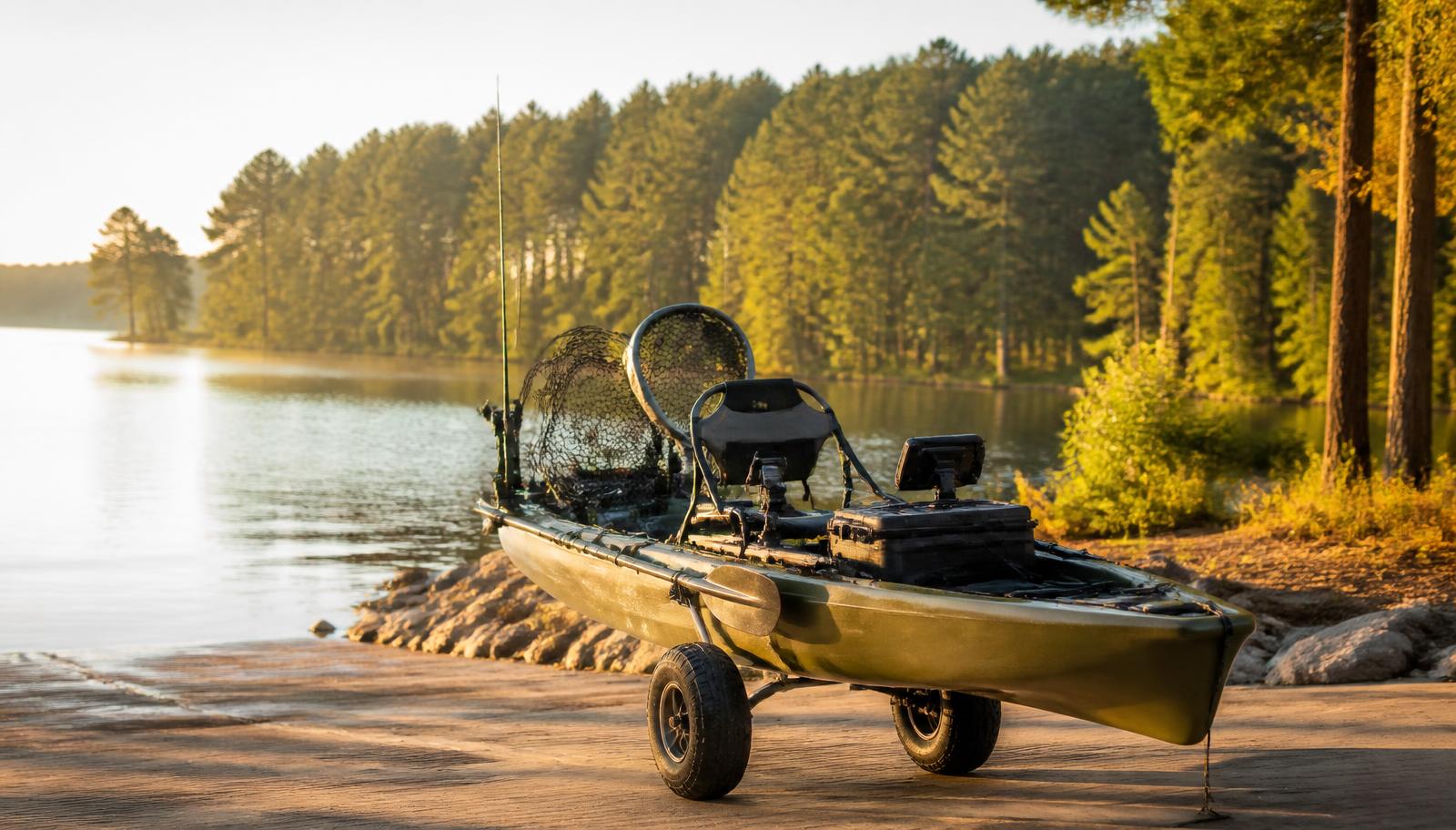
- Launching at the ramp: Transporting your kayak fully rigged allows you to back down the ramp, unsnap your safety chains, float the craft off, and store your trailer in minutes. To move your boat from non-paved ramps to the water's edge, consider pairing your setup with options from our guide to the best kayak carts and dollies.
If you regularly haul heavy fishing setups, browse our recommendations for the best pedal kayaks and best fishing kayaks to ensure your trailer setup matches your gear weight.
Towing Safety, Hitching, and Preventative Maintenance
Towing a light kayak trailer requires following fundamental road safety practices to protect your vehicles and gear.
Calculating Tongue Weight
Your tongue weight should equal roughly 10 to 15 percent of the total combined weight of the trailer and its load. If your trailer weighs 200 pounds and your two kayaks weigh 150 pounds total (350 pounds gross weight), your tongue weight should sit between 35 and 52 pounds. Too little tongue weight causes dangerous trailer sway at high speeds, while too much tongue weight sags your tow vehicle's rear suspension.
Essential Highway Maintenance Checklist
- Check hub grease every trip: Press high-temp marine grease into your bearing caps before long highway drives to prevent bearing failure.
- Verify lighting: Always test turn signals, brake lights, and running lights after hitching up. Marine LED lights are superior to standard incandescent bulbs because their sealed housing prevents water intrusion when backing into launches.
- Inspect tire pressure: Small trailer tires run at higher pressures (often 60 to 90 PSI). Check tire pressure cold before every long drive.
- Secure safety chains: Cross your safety chains under the trailer tongue in an "X" pattern before attaching them to your vehicle's hitch receiver. This catches the tongue if the coupler accidentally disconnects.
For more safety guidelines before setting out, check our detailed breakdown of kayak safety essentials.
Garage Storage Solutions for Small Spaces
Storing a trailer can be tricky if garage space is limited. Fortunately, modern kayak trailers offer several space-saving design features:
- Folding/removable tongues: Models like the Yakima RackandRoll and Malone MicroSport feature quick-release locking pins that allow the long front tongue to slide backward or detach entirely, shrinking the trailer's footprint to under 7 feet long.
- Vertical tilting: Ultralight aluminum trailers can often be tilted vertically against a garage wall using caster wheel kits, occupying just two or three feet of floor depth.
- Integrated storage stands: Frame-mounted bumper pads and rear stands enable safe upright resting without marring the frame or electrical wiring.
Frequently asked questions
What is the maximum highway speed for towing a kayak trailer?
Most kayak trailer manufacturers rate their highway-class tires and frame assemblies for standard highway speeds up to 65 or 70 miles per hour. However, smaller 8-inch wheels spin significantly faster than vehicle tires, creating elevated friction and heat inside the hub bearings. To maximize bearing lifespan and prevent sway, maintaining speeds at or below 65 miles per hour is strongly recommended.
Can I tow a kayak trailer with a compact sedan or hybrid vehicle?
Yes, small sedans, compact hatchbacks, and hybrid vehicles can easily tow lightweight kayak trailers. Because aluminum trailers and basic dual-kayak loads generally weigh under 400 pounds combined, they fall well within the 1,000 to 1,500-pound towing capacities of small passenger cars, requiring only a basic Class 1 hitch receiver installation.
Do kayak trailers require state registration and license plates?
Registration requirements vary by state and country, but most jurisdictions require light utility and boat trailers to be registered, titled, and fitted with an illuminated license plate. Check with your local Department of Motor Vehicles regarding weight thresholds, safety chain rules, and title documentation requirements prior to towing on public roads.
How do I prevent kayak trailer wheel bearings from rusting in saltwater?
To prevent saltwater corrosion, choose trailers with galvanized steel or aluminum axles equipped with marine-sealed grease caps. Always flush your entire axle assembly, hubs, leaf springs, and wheels with fresh tap water immediately after launching in brackish or saltwater environments, and repack wheel bearings with synthetic marine grease regularly.
The bottom line
A quality kayak trailer eliminates the physical strain of roof loading, speeds up your launch times, and lets you haul multiple craft with ease. For general use, the Malone MicroSport offers the ideal balance of payload capacity, durability, and customization. If lightweight construction and smooth suspension are your top priorities for a compact tow vehicle, the Yakima RackandRoll 78 stands out as the top premium option. Choose the trailer that fits your boat count, hitch capacity, and storage footprint to enjoy effortless transport on every paddling trip.
Related Kayaks
Kayaks that pair with this guide

Pungo 120

Loon 120

Catch Mode 110
Keep Reading
Related articles
Best Kayak Carts & Dollies (2026): From Sand to Boat Ramp

Best Kayak Roof Racks: J-Cradles, Saddles & Assists

Best Pedal Kayak Guide (2026): Top Hands-Free Models
Next up: Best Kayak Carts & Dollies (2026): From Sand to Boat Ramp, Best Kayak Roof Racks, and Best Pedal Kayak Guide.