Best Kayak Trolling Motor (2026): Top Drives & Mounts
Transform your fishing setup with the best kayak trolling motor. Compare thrust, mounts, batteries, and registration rules for electric motor setups.

Adding an electric drive to your fishing setup eliminates exhaustion from fighting 15-knot headwinds, triples your effective range, and keeps your hands on your rod when positioning over structure. Whether you want a lightweight transom setup for a budget boat or a high-thrust brushless stern motor for open water, choosing the right combination of thrust, shaft length, and battery capacity is essential. This guide breaks down the best kayak trolling motor options on the market, explains how to mount them, and covers the battery and legal requirements needed to get on the water safely.
Why Motorize Your Kayak? (Thrust, Speed, and Drag Reality)
Before dropping money on an electric drive, you need to understand the physical limits of kayak propulsion. A standard kayak hull has a theoretical maximum hull speed determined by its waterline length. For a 12-foot kayak, that limit sits around 4.5 to 5.2 mph. Pushing past this threshold requires exponentially more energy because you are essentially trying to climb over your own bow wave.
For this reason, a 55 lb thrust motor will not make your kayak fly across the lake at 15 mph. Instead, higher thrust gives you two specific advantages: maintaining cruising speed in heavy wind and current, and pushing heavy, fully rigged vessels loaded with gear.
- 24 lb to 36 lb Thrust: Ideal for standard 10-foot to 12-foot kayaks weighing under 300 lbs total loaded weight. Cruising speed averages 3.0 to 3.8 mph.
- 40 lb to 55 lb Thrust: Designed for heavy 12-foot to 14-foot fishing kayaks loaded with crates, batteries, and livewells (400+ lbs total). Cruising speed sits around 4.2 to 4.8 mph with reserve power for fighting tidal flow.
- Direct-Drive Brushless Systems (e.g., Torqeedo, Newport NK180): Offer high efficiency and higher top-end output (up to 5.5 mph), but at a significantly higher price point.
If you regularly fish large reservoirs, coastal estuaries, or rivers with 3-knot currents, motorizing is a game changer. If you stick to small farm ponds, a quality paddle or pedal system from our guide to the best pedal kayaks might still be your simplest path.
Top 5 Kayak Trolling Motors Reviewed
1. Newport Vessels NK180 Brushless Kayak Motor
The Newport Vessels NK180 is purpose-built for kayak anglers who want maximum efficiency without adapting a heavy transom-mount motor designed for a johnboat. Powered by a 24V brushless direct-drive motor, the NK180 delivers the equivalent output of a 60 lb thrust brushed motor while remaining surprisingly quiet underwater.
- Thrust: Equivalent to 60 lbs (24V system)
- Weight: 14.3 lbs (motor and bracket assembly)
- Shaft Length: 19.7 inches (customizable depth)
- Best For: Serious anglers running stern-mounted setups on heavy sit-on-top hulls
Because the NK180 uses a digital speed controller with reverse, power consumption scales linearly with speed. At half throttle (approx 3.2 mph on a standard rig), it draws roughly 10 amps, giving you all-day range on a 24V 50Ah LiFePO4 battery. The steering cables integrate directly into foot-brace systems or hand-steering levers. The main downside is cost and the requirement for a 24V battery setup, which means either running two 12V batteries in series or buying a dedicated 24V lithium pack.
2. Newport Vessels Kayak Series 36lb / 55lb Electric Motor
If you want a native 12V motor built specifically for kayak transom brackets, the Newport Vessels Kayak Series is the industry standard benchmark. Unlike standard trolling motors with 36-inch or 42-inch shafts that stick up into your casting stroke, this series features a 24-inch fiberglass shaft that keeps the top head low and out of the way.
- Thrust Options: 36 lbs or 55 lbs (12V)
- Weight: 18 lbs (36lb) / 23 lbs (55lb)
- Shaft Length: 24 inches
- Best For: Transom-mount setups on budget and mid-tier fishing kayaks
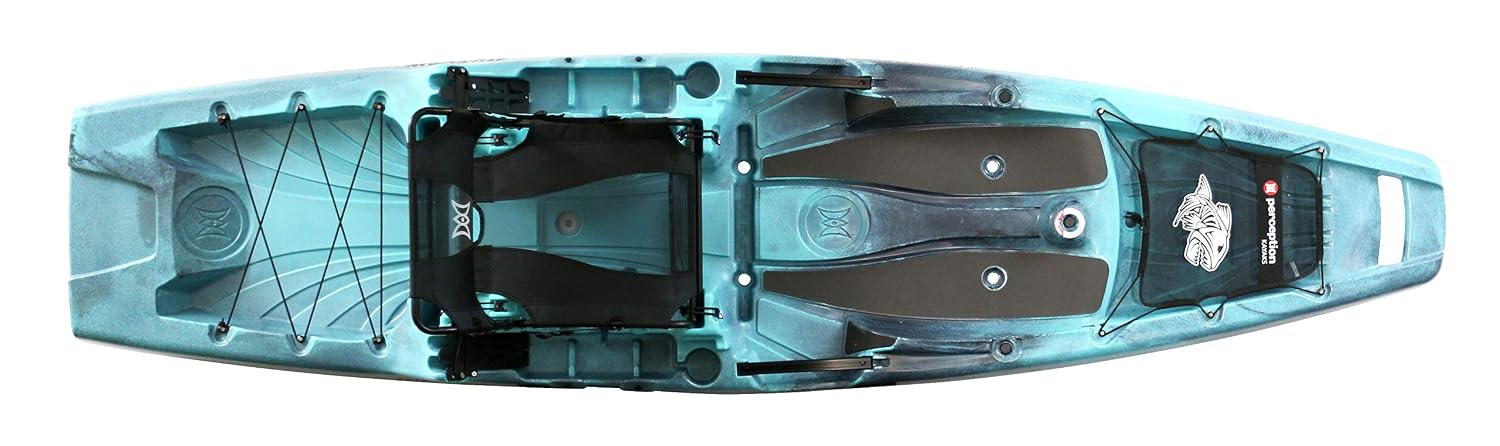
The motor includes extended 5-foot battery cables, allowing you to place your heavy lithium battery in the forward hatch or center console to balance your kayak's center of gravity. The 5-forward/3-reverse speed switch is robust, though not as smooth as infinitely variable digital throttles. Pairing the 36 lb version with a compact hull like the Perception Pescador Pro 10 (read our Perception Pescador Pro 10 review) creates a nimble, lightweight setup that handles small lakes effortlessly.
3. Minn Kota Endura C2 30
The Minn Kota Endura C2 30 is the most popular budget modification motor in the world. While designed originally for small jonboats and inflatable dinghies, its 30-inch composite shaft is indestructible—flexing on impact with rocks or submerged logs instead of bending or breaking.
- Thrust: 30 lbs (12V)
- Weight: 16 lbs
- Shaft Length: 30 inches (often DIY cut down to 20-24 inches)
- Best For: DIY builders looking for maximum reliability under $150
The Endura C2 30 draws a maximum of 30 amps at top speed (Speed 5), making it exceptionally battery-friendly. On a budget rig like the Lifetime Tamarack Angler 100 (see our full Lifetime Tamarack Angler 100 review), mounting an Endura C2 via a side-gunwale mount gives you effortless cruising for minimal investment. The only trade-off is the 30-inch shaft length, which sits higher than dedicated kayak motors unless you choose to disassemble the head unit and cut the composite shaft down yourself.
4. Watersnake Aspire T18 / T24 Kayak Motor
For ultra-lightweight setups, small sit-in kayaks, or anglers who just want a small boost to assist their paddle strokes, the Watersnake Aspire series offers minimal footprint and weight.
- Thrust: 18 lbs or 24 lbs (12V)
- Weight: 7.7 lbs (T18) / 9.5 lbs (T24)
- Shaft Length: 24 inches
- Best For: Lightweight sit-on-top hulls, inflatables, and side-mount setups
Weighing under 10 pounds, the Watersnake T24 places minimal stress on plastic hulls and gunwale mounts. It uses a simple high/low speed switch with forward and reverse controls. While it won't push a 100-pound fishing kayak through a 4-knot inlet tide, it easily cruises a 10-foot craft like the Pelican Sentinel 100X Angler (check our Pelican Sentinel 100X Angler review) at 3 mph while drawing under 15 amps.
5. Torqeedo Ultralight 1103 AC
At the top end of the engineering spectrum sits the Torqeedo Ultralight 1103 AC. This complete system includes a 1100W direct-drive motor (equivalent to a 3 HP gas outboard), an integrated high-capacity lithium battery, an onboard magnetic kill switch, and a digital throttle with real-time GPS range and speed calculation.
- Thrust: 1100 Watts / 3 HP equivalent (29.6V system)
- Weight: 33 lbs total (motor, mount, throttle, AND battery included)
- Shaft Length: 19.7 inches
- Best For: Professional tournament anglers and long-distance expedition paddlers
The Ultralight 1103 AC mounts directly to the stern tracking area or existing rudder mounts of high-end fishing kayaks. At top speed, it propels heavy hulls at over 5.5 mph. At a 3 mph trolling speed, the included 915 Wh lithium battery provides over 18 miles of range. It represents the pinnacle of performance, though its premium price tag makes it a serious investment.
Kayak Trolling Motor Comparison Table
| Motor Model | Thrust / Power | Voltage | Weight (Motor Only) | Shaft Length | Speed Control | Recommended Battery |
|---|---|---|---|---|---|---|
| Newport NK180 | 60 lb equiv. | 24V | 14.3 lbs | 19.7 in | Step-less PWM Digital | 24V 50Ah LiFePO4 |
| Newport Kayak Series 36 | 36 lbs | 12V | 18.0 lbs | 24 in | 5 Forward / 3 Reverse | 12V 50Ah LiFePO4 |
| Newport Kayak Series 55 | 55 lbs | 12V | 23.0 lbs | 24 in | 5 Forward / 3 Reverse | 12V 100Ah LiFePO4 |
| Minn Kota Endura C2 30 | 30 lbs | 12V | 16.0 lbs | 30 in | 5 Forward / 3 Reverse | 12V 50Ah LiFePO4 |
| Watersnake Aspire T24 | 24 lbs | 12V | 9.5 lbs | 24 in | High / Low Switch | 12V 30Ah LiFePO4 |
| Torqeedo Ultralight 1103 | 1100W (3HP equiv) | 29.6V | 19.6 lbs (excl. bat) | 19.7 in | Step-less PWM Digital | Included 915Wh Li-Ion |
Mounting Configurations Explained
How you attach the motor to your hull drastically affects tracking, steering, balance, and ease of operation. There are three primary mounting methods used by kayak anglers.
                     [ Stern Mount ]
                   (Best tracking & efficiency)
                            |
  +-------------------------v-------------------------+
  |                                                   |
  |  [Side Mount]                       [Pedal Drive] |
  |  (Easiest reach)                    (Mid-ship Pod)|
  +---------------------------------------------------+
1. Stern Mount (Rear Transom / Rudder Location)
Stern mounting is the gold standard for tracking and hydrodynamic efficiency. By pushing the kayak from directly behind the stern centerline, the hull tracks straight without yawing to one side.
- Pros: Outstanding tracking, keeps gunwales clear for landing fish, optimal weight distribution when paired with a bow-placed battery.
- Cons: Harder to manually reach the motor head to clear weeds or raise the shaft when entering shallow water unless equipped with a pull-cable deployment system.
- Best Bracket Options: Look for a universal stern transom bracket or a track-mounted stern plate. Search for a universal kayak stern motor mount to fit your specific hull tracks.
2. Side-Gunwale Mount (Cross-Bar Style)
A side mount uses a crossbar clamped across the rear gear tracks or rod holders behind the seat, positioning the motor off to one side of the hull.
- Pros: Inexpensive, easy to install without drilling permanent holes, and allows immediate physical access to the motor tiller handle to tilt, adjust depth, or reverse.
- Cons: Creates asymmetric drag, causing the kayak to pull slightly to one side. Can interfere with net landing space on that side of the boat.
- Best Use: Great for budget setups, smaller 10-foot kayaks, or anglers who only use the motor for long transits and paddle while fishing.
3. Drive-Pod / Mid-Ship Drop-In Mounts
Some specialized kayaks feature removable floor pods (often used for pedal drives or transducers). Aftermarket kits allow you to drop small motor pods directly into this center scupper/drive cavity.
- Pros: Perfect weight distribution right under the seat, easy access to clear debris, zero interference with casting or stern gear space.
- Cons: Occupies the space meant for your pedal drive system, reduces clearance in skinny water, and requires a hull specifically designed with a center drive cavity.
Batteries, Wiring, and Power Management
Running out of power 3 miles from the boat ramp is no fun. Setting up your power system correctly ensures safety and maximum run time.
Lithium (LiFePO4) vs. Lead-Acid (AGM)
Never buy a standard lead-acid or AGM deep-cycle battery for a kayak if your budget allows for lithium. A standard 12V 100Ah AGM battery weighs roughly 60 to 65 lbs. A 12V 100Ah Lithium Iron Phosphate (LiFePO4) battery weighs between 22 and 25 lbs while delivering flat voltage output across 95% of its discharge cycle.
- 12V 50Ah LiFePO4 Battery: Weighs ~13 lbs. Excellent for 30lb-36lb thrust motors running 4–6 hours at mixed trolling speeds. Search for a 12v 50ah lifepo4 marine battery with a built-in Battery Management System (BMS).
- 12V 100Ah LiFePO4 Battery: Weighs ~24 lbs. Mandatory for 55lb thrust motors or full-day river trips against heavy current.
Essential Wiring Safety Gear
- Marine-Grade Circuit Breaker: You must install a manual-reset circuit breaker on the positive cable within 12 inches of the battery terminal. Use a 40A breaker for 30lb motors and a 50A/60A breaker for 55lb motors. This prevents electrical fires if the prop gets snagged in heavy hydrilla or strikes a boulder. Check out a 50 amp marine circuit breaker.
- Wire Gauge (AWG): Trolling motors draw high continuous current. For cable runs up to 7 feet, 10 AWG tinned copper wire is acceptable for 30lb motors. For 55lb motors or cable runs exceeding 8 feet (from stern to bow hatch), always use 8 AWG or 6 AWG wire to prevent voltage drop and overheating.
- Waterproof Connectors: Use quick-disconnect marine plugs (like SAE or Anderson Powerpole connectors) to make battery removal fast during transport. Learn more about properly securing your boat in our guide on how to transport and store a kayak.
[Lithium Battery] ---> (Inline Fuse/Breaker) ---> [Quick Disconnect Plug] ---> [Trolling Motor]
Legal Requirements: Registration and Waterways
Here is a crucial rule that catches many kayak anglers off guard: In almost all US states and Canadian provinces, adding any electric motor—regardless of size or thrust—instantly reclassifies your kayak as a motorized vessel.
Once motorized, you are legally required to:
- Register the kayak: You must obtain a state title/registration, pay a fee, and apply registration numbers and validation decals to both sides of the bow.
- Carry Required Safety Equipment: You must carry a Coast Guard-approved PFD, a whistle or sound-producing device, and a 360-degree white navigation light if operating between sunset and sunrise. Review our full list of kayak safety essentials before hitting the water.
- Display Hull Identification Numbers (HIN): Most state fish & wildlife agencies require your kayak's molded-in 12-digit HIN to complete the registration paperwork.
Always check your state's Department of Natural Resources (DNR) or boating authority rules before installing a motor. Fines for operating an unregistered motorized vessel can easily exceed $150.
How to Rig Your Motorized Kayak for Success
Adding a motor changes how your kayak sits in the water. Follow these rigging rules to keep your boat stable and organized:
- Counterbalance Heavy Components: If your motor is mounted on the stern (20 lbs), place your lithium battery (15-25 lbs) in the forward bow hatch or front cargo well. This keeps the bow down and prevents plow drag.
- Keep Steering Lines Taut: If using foot-brace steering cables on a stern motor, check tension before launching. Loose cables create slop in your steering and make tracking in crosswinds frustrating.
- Integrate Electronics Wisely: Running a motor and a depth finder off the same battery can introduce electrical noise (sonar interference) onto your screen. Run your motor on its own dedicated battery, and use a smaller 12V 10Ah battery for your electronics. For display recommendations, read our guide to the best kayak fish finder.
- Carry an Anchor System: When fishing high-current areas with a motor, having a reliable anchor pin or folding anchor lets you lock down your position without burning battery juice. See our picks for the best kayak anchor.
If you are still deciding on the underlying boat platform before building out an electric setup, check out our roundup of the best fishing kayaks to find stable, high-capacity hulls built for motor rigging.
Frequently asked questions
How fast will a 55 lb thrust trolling motor push a kayak?
A 55 lb thrust trolling motor will typically push a fully loaded 12-foot to 14-foot fishing kayak at a top speed of 4.2 to 4.8 mph. Kayak hulls are displacement hulls, meaning top speed is limited by waterline length rather than horsepower. The primary advantage of a 55 lb thrust motor is not extra speed, but rather the ability to maintain 4 mph against strong headwinds, tidal currents, and heavy wave action.
Do I need to register my kayak if I add a trolling motor?
Yes, in nearly all US states, adding an electric trolling motor to a non-powered kayak automatically reclassifies it as a motorized vessel. You must register the boat with your state's boating authority or DNR, pay a registration fee, and display official registration numbers and stickers on the bow. Operating an unregistered motorized kayak can result in citations from marine law enforcement.
What size battery do I need for a kayak trolling motor?
For a standard 12V 30lb to 55lb thrust motor, a 12V 50Ah to 100Ah LiFePO4 lithium battery is recommended. A 50Ah lithium battery provides roughly 3 to 5 hours of mixed trolling run time, while a 100Ah pack easily handles full-day trips. Lithium batteries are strongly preferred over lead-acid batteries because they weigh up to 70 percent less while delivering consistent voltage throughout their entire charge.
Can I put a trolling motor on an inflatable kayak?
Yes, you can put a trolling motor on an inflatable kayak, provided the hull features a reinforced transom or compatible motor mount structure. Motors with 18 lb to 30 lb thrust are ideal for inflatables to prevent excessive torque from twisting the PVC tubes. You can learn more about hull differences and material limitations in our detailed guide on inflatable vs hard shell kayaks.
The bottom line
Motorizing your fishing kayak transforms your time on the water by eliminating physical fatigue, expanding your search radius, and giving you precise boat control over structure. For most anglers running standard sit-on-top hulls, the Newport Vessels Kayak Series 36lb or Minn Kota Endura C2 30 combined with a 12V 50Ah LiFePO4 battery offers the ultimate balance of weight, price, and performance. If you want maximum brushless efficiency and seamless steering integration, invest in the Newport Vessels NK180. Rig your wiring with a proper circuit breaker, balance your battery weight, register your hull with your local DNR, and enjoy effortless power on your next fishing adventure.
Related Kayaks
Kayaks that pair with this guide
Pescador Pro 10.0

Pungo 120

Catch Mode 110
Keep Reading
Related articles

Best Kayak Fish Finder Picks of 2026: Sonar, GPS & Mounts

Best Pedal Kayak Guide (2026): Top Hands-Free Models

The Best Fishing Kayaks (2026 Guide)
Next up: Best Kayak Fish Finder Picks of 2026: Sonar, GPS & Mounts, Best Pedal Kayak Guide : Top Hands-Free Models, and Best Fishing Kayaks.