Best Kayak Fish Finder Picks of 2026: Sonar, GPS & Mounts
Upgrade your kayak setup with the best kayak fish finder options for 2026. Compare compact CHIRP, side-imaging, portable castables, and low-draw battery setups.

Mounting a sonar unit to a small craft used to mean dragging heavy marine batteries, drilling sketchy hull holes, and dealing with clumsy transducer arms. Modern fish finders cut battery draw down to fractions of an amp while offering side-scanning detail and built-in GPS mapping scaled perfectly for small cockpits. Whether you are navigating timber-choked reservoirs or targeting coastal drop-offs, picking the best kayak fish finder comes down to balancing screen real estate, power draw, and hull mounting logistics.
Adding sonar completely alters how you read structure, bottom hardness, and fish posture on the water. Pairing clear unit displays with stable fishing platforms like the Perception Pescador Pro 10 (Amazon) gives you full control over your drift lines and presentation depths.
Kayak Fish Finder Comparison
| Model / Unit Class | Screen Size | Power Draw | Sonar Tech | Best Mounting Method | Target Use Case | Price Range |
|---|---|---|---|---|---|---|
| Compact 4-Inch CHIRP | 4.3" (272x480) | ~0.23A @ 12V | Dual-Beam CHIRP + ClearVü | Scupper / Transducer Arm | Small craft & budget setups | $130 - $180 |
| Mid-Size Side-Imaging | 7.0" (800x480) | ~0.55A @ 12V | CHIRP + DownScan + SideScan | In-Hull Puck / Track Arm | Large lakes & coastal weedlines | $450 - $650 |
| Castable Wireless | Phone Display | Internal Rec. | Dual/Triple Frequency Sonar | Tethered / Arm Mount | Inflatables & ultra-light launches | $100 - $220 |
| Standalone 5-Inch GPS | 5.0" (800x480) | ~0.40A @ 12V | CHIRP 2D + Down Imaging | Direct Track Mount | Rivers, ponds & tight cockpits | $280 - $380 |
| Live-Sonar Capable 7-Inch | 7.0" (1024x600) | ~1.0A @ 12V | Forward-Facing / CHIRP | Custom Track / Scupper | Open-water Tournament Anglers | $750 - $1,200 |
Top Standout Kayak Fish Finders
1. Garmin Striker Vivid 4cv – Best Overall Value for Small Cockpits
If you want crystal-clear bottom detail without sacrificing your footwell space, a 4-inch display striking the middle ground of power and readability is hard to beat. The Garmin Striker Vivid 4cv remains an industry standard for compact kayaks because it pulls less than a quarter-amp of power per hour. That means a tiny 7Ah battery powers the display through two full days on the water.
- Display: 4.3-inch diagonal display running 272 x 480 pixel resolution.
- Frequencies: Traditional CHIRP (50/77/200 kHz) plus ClearVü scanning (260/455/800 kHz).
- Power Draw: 0.23 amps at 12V DC.
- GPS Capabilities: High-sensitivity GPS built-in for marking waypoints, routes, and creating customized 1-foot contour maps via Quickdraw Contours (no built-in chartplotter base maps).
Its high-contrast Vivid color palettes make reading bottom transitions through polarized sunglasses effortless, even in bright overhead glare. Mounting the transducer inside a recessed hull pocket on budget sit-on-top rigs like the Lifetime Tamarack Angler 100 (Amazon) protects the crystal when beaching on gravel ramps.
2. Lowrance Hook Reveal 7 TripleShot – Best Side-Scan Sonar Pick
Scanning tight cover, bridge pilings, and timber edges to the sides of your hull requires side-imaging technology. The Lowrance Hook Reveal 7 TripleShot packages SideScan, DownScan, and high CHIRP sonar into an automated setup that eliminates continuous frequency tweaking.
- Display: 7-inch SolarMAX widescreen display (800 x 480 pixels).
- Sonar Capabilities: High CHIRP, SideScan (455/800 kHz), DownScan Imaging, and FishReveal technology overlaying fish arches onto DownScan visuals.
- Current Draw: Approximately 0.90A @ 12V DC (requires a 10Ah to 12Ah LiFePO4 battery for full-day trips).
- Mapping: Pre-loaded C-MAP US Inland charts with Genesis Live real-time mapping.
The TripleShot transducer is physically long—measuring nearly 9 inches—so it requires a dedicated transducer arm or an open scupper cavity. It is a perfect pairing for wide stability-focused hulls when you are serious about fishing from a kayak in large impoundments.
3. Deeper Smart Sonar PRO+ – Best Portable Pick for Inflatables
Not every paddler wants to wire a 12-volt battery box or bolt bracket tracks onto their deck. The Deeper Smart Sonar PRO+ casts out up to 330 feet or mounts to a flexible arm, streaming high-resolution 2D sonar straight to your smartphone or tablet via built-in Wi-Fi.
- Weight: 3.1 oz spherical castable transducer.
- Target Separation: 0.4 inches (Narrow Beam), 1 inch (Medium Beam), 2.4 inches (Wide Beam).
- Scan Depth Range: 6 inches down to 330 feet.
- Battery Life: Internal Lithium Polymer battery providing up to 9 hours of continuous operation (recharges via USB-C in 2 hours).
If you launch lightweight craft such as the Sea Eagle 370 (Amazon), carrying heavy lead-acid power packs makes zero sense. The Deeper system keeps your total setup weight under a pound while delivering real-time depth mapping. Read more about light-craft setups in our guide to inflatable vs hard-shell kayaks.
4. Humminbird HELIX 5 CHIRP GPS G2 – Best Mid-Size Standalone Display
For paddlers who find 4-inch screens too cramped for split-screen navigation, the Humminbird HELIX 5 CHIRP GPS G2 offers landscape 16:9 widescreen viewing. The 800 x 480 resolution display provides plenty of visual room to monitor DualSpectrum CHIRP sonar side-by-side with AutoChart Live mapping.
- Display: 5-inch 16:9 widescreen color display.
- Sonar: Dual Spectrum CHIRP with 42-degree wide beam and 25-degree narrow beam coverage.
- Current Draw: 0.61A at 12V DC.
- Features: MicroSD card slot for recording maps, saving waypoints, and running Humminbird LakeMaster charts.
The horizontal layout mounts neatly on track brackets without blocking paddle strokes or forward vision on mid-sized sit-on-top hulls like the Pelican Sentinel 100X Angler (Amazon).
Sonar Technologies Explained for Kayak Anglers
Understanding the trade-offs between different sonar frequencies prevents buying features you will never use in shallow water.
Traditional 2D CHIRP
Traditional sonar sweeps a continuous range of frequencies (such as 50 to 200 kHz) into a cone under the hull. It excels at showing depth changes, bottom composition, and fish arches while your kayak moves. Because the cone angle is wider (typically 15 to 45 degrees), it keeps your lure visible under the boat when vertical jigging.
DownScan / ClearVü
DownScan uses high-frequency, ultra-narrow beams (455 kHz or 800 kHz) to create photo-like slices of structure directly beneath the kayak. Brush piles look like trees, and rock walls show individual crevices. High frequencies trade maximum depth penetration for crisp detail, making them ideal for water under 100 feet deep.
SideScan / SideVü
Side-imaging shoots thin lateral sonar beams up to 240 feet to the left and right of your hull. It allows you to search large weedbeds or flats without paddling over top of skittish fish in shallow water. However, reading side-scan displays requires maintaining a straight tracking course at 1.5 to 3.5 mph. If your kayak lacks a rudder or pedal drive system like those detailed in our best pedal kayaks guide, wind drift will distort side-imaging visuals.
Transducer Mounting Methods on Kayaks
Getting a clean, bubble-free signal out to your unit screen requires matching your transducer mount to your hull material and layout.
Kayak Mounting Solutions Overview
 ├── Scupper Recess  ──> Streamlined, sub-hull protection, no drag
 ├── In-Hull (Shoot-Thru) -> Clean deck setup, loses water temp accuracy
 └── Flex Track Arm  ──> Universal fit, adds water drag, easy removal
Scupper Hole Mounting
Many fishing-focused hulls feature shaped scupper cavities on the underside designed to recess transducers flush with the keel line.
- Pros: Cleanest deck installation, optimal transducer angle, zero drag, reads accurate surface water temperature.
- Cons: Requires unit-specific scupper mounts; exposes the transducer face to scrapings during shallow beach landings.
In-Hull (Shoot-Through-Hull) Mounting
Polyethylene sit-on-top hulls are thin enough for 2D sonar signals to penetrate directly through solid plastic without drilling holes.
- Pros: Keeps the transducer protected inside the hull; no exposed cables or drag on the hull surface.
- Cons: DownScan detail drops slightly; eliminates precise water temperature readings; will not work on multi-layer composite or thermoformed hulls like those featured in our breakdown of sit-in vs sit-on-top kayaks.
- Method: Use duct seal putty or non-slumping marine silicone inside the dry hull hatch. Press the transducer into the adhesive block firmly to eliminate trapped air bubbles between the transducer crystal and plastic.
Track-Mounted Flex Arms
For paddlers swapping fish finders across multiple boats, a track-mounted transducer arm fastens directly to standard accessory gear tracks.
- Pros: Fast setup and teardown; compatible with any hard-shell kayak or inflatable outfitted with accessory tracks.
- Cons: Introduces asymmetrical drag while paddling; collects floating weeds and debris in shallow bays.
Powering Your Kayak Fish Finder: Batteries & Wiring
Power management is crucial for kayak rigging. Running out of juice midway through a fishing trip leaves you blind to offshore structure.
Battery Selection: Sealed Lead-Acid (SLA) vs. LiFePO4
- Sealed Lead-Acid (SLA 12V 7Ah): Cost-effective ($20-$30), but heavy (4.5 to 5.0 lbs). SLA batteries experience voltage drops after 50% discharge, causing high-draw color fish finders to shut down unexpectedly.
- Lithium Iron Phosphate (LiFePO4 12V 10Ah-12Ah): Costs more ($60-$110), but weighs less (under 2.5 lbs). LiFePO4 batteries deliver constant 12.8V output through 95% of their discharge cycle and endure over 2,000 charge cycles.
Wiring & Waterproofing Basics
- Inline Fuse: Always install a waterproof inline fuse holder on the positive (red) lead close to the battery terminal (typically 3-amp for 4-to-5-inch screens; 5-amp for 7-inch displays).
- Thru-Hull Grommets: Route cables into internal hull cavities using split-rubber thru-hull grommets (like YakAttack or Fasten hardware) to keep water out during heavy chop.
- Dry Box Storage: Keep batteries inside a small marine dry box or water-resistant battery bag secured beneath your seat frame. Check out our advice on essential accessories in kayak fishing 101.
How to Choose the Right Setup for Your Kayak
- Evaluate Screen Size vs. Cockpit Size: If you fish from a narrow 10-foot paddle kayak, a 7-inch display blocks your paddle arc and sightlines. Stick to a 4-inch or 5-inch display mounted to a gear track.
- Check Your Transport Rig: Extra gear depth matters. If you load your hull bottom-down using a truck bed setup like detailed in how to transport a kayak in a truck bed, make sure bottom-mounted transducers don't crush against the tailgate.
- Match Your Budget: A $150 unit like the Garmin Vivid 4cv leaves plenty of headroom in your budget for essential gear covered in our kayak safety essentials guide.
Frequently asked questions
Can you shoot a fish finder transducer through a solid plastic kayak hull?
Yes, 2D CHIRP sonar transducers shoot through high-density polyethylene hulls without issue if mounted without air bubbles. You can seat the transducer puck using a block of duct seal putty or marine sealant applied inside an interior dry hatch. Note that high-frequency DownScan and SideScan imaging lose clarity through plastic, and surface water temperature readings will be delayed.
How long will a 12V 10Ah lithium battery run a kayak fish finder?
Runtime depends on screen size, brightness settings, and current draw. A compact 4-inch display pulling 0.25 amps runs for up to 40 hours on a 10Ah LiFePO4 battery. A larger 7-inch side-imaging unit drawing 0.75 amps delivers 12 to 13 hours of continuous runtime on a single charge.
Do you need a GPS built into your kayak fish finder?
Having a built-in GPS receiver is worth the small extra cost for open-water safety and mapping efficiency. Integrated GPS lets you drop waypoints on productive brush piles, lay down drift lines across drop-offs, and safely navigate back to the launch ramp during heavy fog or after sunset.
Is side-scan sonar useful on a traditional paddle kayak?
Side-scan sonar works best when you maintain a straight tracking speed between 2 and 4 miles per hour. While paddle kayaks can drift off-course from wind or paddle strokes, adding a rudder or using a pedal-drive kayak stabilizes your track enough to create clear side-imaging pictures.
The bottom line
Rigging your kayak with the right fish finder eliminates guesswork on depth, bottom structure, and target locations. For most paddlers, a compact unit like the Garmin Striker Vivid 4cv offers the ideal balance of clear CHIRP sonar, minimal battery consumption, and a compact footwell footprint. If you need wide side-scanning detail on larger bodies of water, scale up to a 7-inch unit powered by a lightweight LiFePO4 battery. Pick a transducer mount that protects your gear, wire it cleanly, and focus on landing more fish.
Related Kayaks
Kayaks that pair with this guide
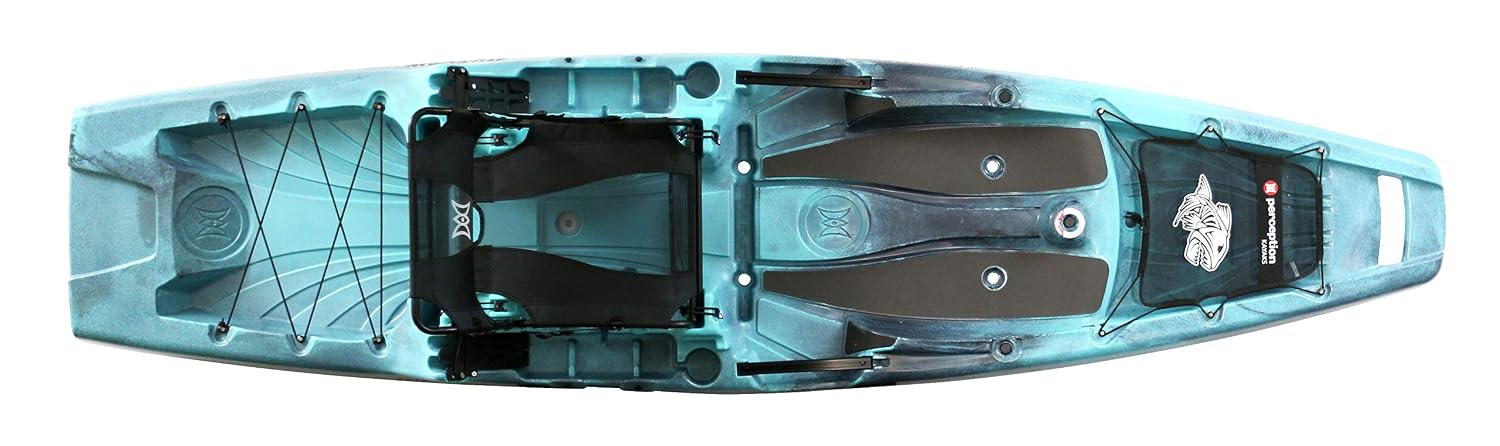
Pescador Pro 10.0

Pungo 120

Catch Mode 110
Keep Reading
Related articles

Best Kayak Trolling Motor (2026): Top Drives & Mounts

Best Pedal Kayak Guide (2026): Top Hands-Free Models

The Best Fishing Kayaks (2026 Guide)
Next up: Best Kayak Trolling Motor (2026): Top Drives & Mounts, Best Pedal Kayak Guide : Top Hands-Free Models, and Best Fishing Kayaks.